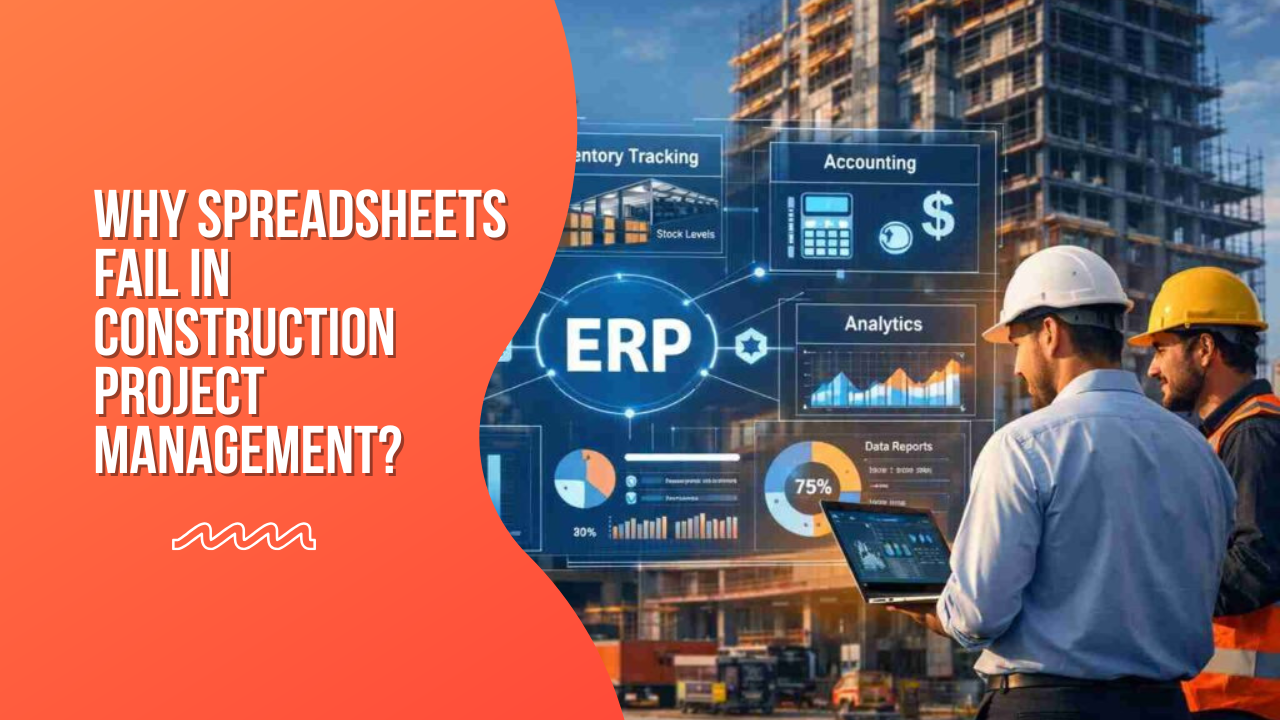
Walk into any construction company’s back office, and there’s a good chance you’ll find a maze of spreadsheets — color-coded tabs, complex formulas, and files named things like “Final_Budget_v3_ACTUAL_USE_THIS_ONE.xlsx.” It’s almost a rite of passage in the industry. And honestly, it makes sense why spreadsheets became so popular — they’re flexible, familiar, and free. But here’s the uncomfortable truth: as construction projects grow in complexity, spreadsheets start cracking under the pressure. More and more project managers and firm owners are turning to reputable & specialized construction ERP software to replace the patchwork of spreadsheets that have been holding their operations together. The reasons for this shift aren’t just about technology — they’re about survival in an industry where margins are thin, timelines are tight, and the cost of a mistake can be enormous.

The Illusion of Control
Spreadsheets feel like control. You can see every number, every formula, every row. But that feeling is often an illusion. When you’re managing a multi-million-dollar construction project across multiple sites, subcontractors, and timelines, a spreadsheet gives you a snapshot — not a living, breathing view of what’s actually happening. The moment you save that file and close it, it starts aging. Someone updates the schedule, a change order comes in, an invoice lands — but unless someone manually updates the spreadsheet, the data is already stale. In construction, stale data doesn’t just create confusion. It creates rework, budget overruns, and missed deadlines.
Version Control: A Disaster Waiting to Happen
Here’s a scenario that plays out constantly: a project manager sends a budget spreadsheet to the site supervisor. The supervisor makes edits and sends it back. Meanwhile, the finance team has been working off the original version. Now you have three versions of the truth — and no one knows which one is right. Version control is one of the most persistent, painful problems with spreadsheet-based management. In construction, where dozens of people across multiple roles need to access and update the same information, this isn’t a minor inconvenience. It’s a structural flaw that leads to billing disputes, subcontractor conflicts, and real financial consequences.
No Real-Time Visibility
Construction projects are dynamic. On any given day, you might be dealing with delayed materials, a subcontractor pulling their crew, or a sudden change order from the client. Decision-makers need up-to-the-minute information. Spreadsheets can’t provide that. They require someone to manually input data, and that person usually has a dozen other things on their plate. By the time leadership reviews the numbers, the situation has already evolved. You’re making decisions based on where you were, not where you are.
The Human Error Problem
Spreadsheets rely entirely on humans for data entry — and humans make mistakes. A misplaced decimal, a broken formula, a row accidentally deleted — these aren’t hypothetical risks. In construction, where numbers directly translate to materials purchased, labor scheduled, and contracts signed, a single spreadsheet error can cascade into serious financial damage. The problem compounds as files grow larger. The more complex the formulas and linked workbooks, the harder it becomes for anyone to verify that everything is working correctly. Most people just trust the numbers because they don’t have time to audit every formula.

Collaboration Breaks Down
Construction project management is fundamentally collaborative. Owners, general contractors, subcontractors, architects, engineers, and site supervisors all need access to project information. Spreadsheets were never designed for this kind of multi-user environment. You can share a Google Sheet or drop a file on a shared drive, but the result is a fragile system held together by discipline and hope. People overwrite each other’s work. Updates get missed. Over time, teams develop their own workarounds — which means you now have multiple systems instead of one, and the data problem has only gotten worse.
Reporting Takes Too Long
Ask a project manager using spreadsheets to produce a status report, and they’ll tell you it takes hours — pulling data from multiple tabs, cross-referencing purchase orders, reconciling with accounting records. And the moment the report is finished, it’s already outdated. In a competitive construction environment, generating accurate, timely reports isn’t a luxury — it’s a requirement. Clients expect transparency. Banks and bonding companies want financial clarity. Spreadsheets make all of this harder than it needs to be.
No Audit Trail, No Compliance Safety Net
Construction projects involve complex compliance requirements — certified payroll, lien waiver tracking, safety regulations, and more. Spreadsheets have no built-in compliance framework and no automatic audit trail. Cells get overwritten with no record of what was there before. Formulas change silently. When disputes arise — and in construction, they always do — you need a clear record of decisions, approvals, and changes. A spreadsheet can’t reliably provide that. If a project ends up in litigation or an audit, a folder full of spreadsheets is a liability, not an asset.
Scaling Is Practically Impossible
When a small firm takes on its first big project, spreadsheets may barely hold together. But as the company grows — more projects, more employees, more subcontractors — the model collapses. Files become too large to open quickly. Linked workbooks multiply. The one person who understands how everything connects becomes a dangerous single point of failure. Scaling a construction business requires infrastructure that grows with you. Spreadsheets don’t scale. They become a ceiling rather than a foundation.
Time to Move Beyond Spreadsheets
The construction industry is changing fast. Projects are more complex, clients demand more transparency, and margins are under constant pressure. The firms pulling ahead aren’t the ones clinging to spreadsheets out of habit — they’re the ones investing in tools that deliver real-time visibility, reliable data, and room to grow. If your team is still running projects on spreadsheets, the question isn’t whether they’ll eventually fail you. It’s when. Making the move to the best construction ERP software for your firm’s needs is one of the smartest decisions you can make — not just for day-to-day efficiency, but for the long-term health of your business.